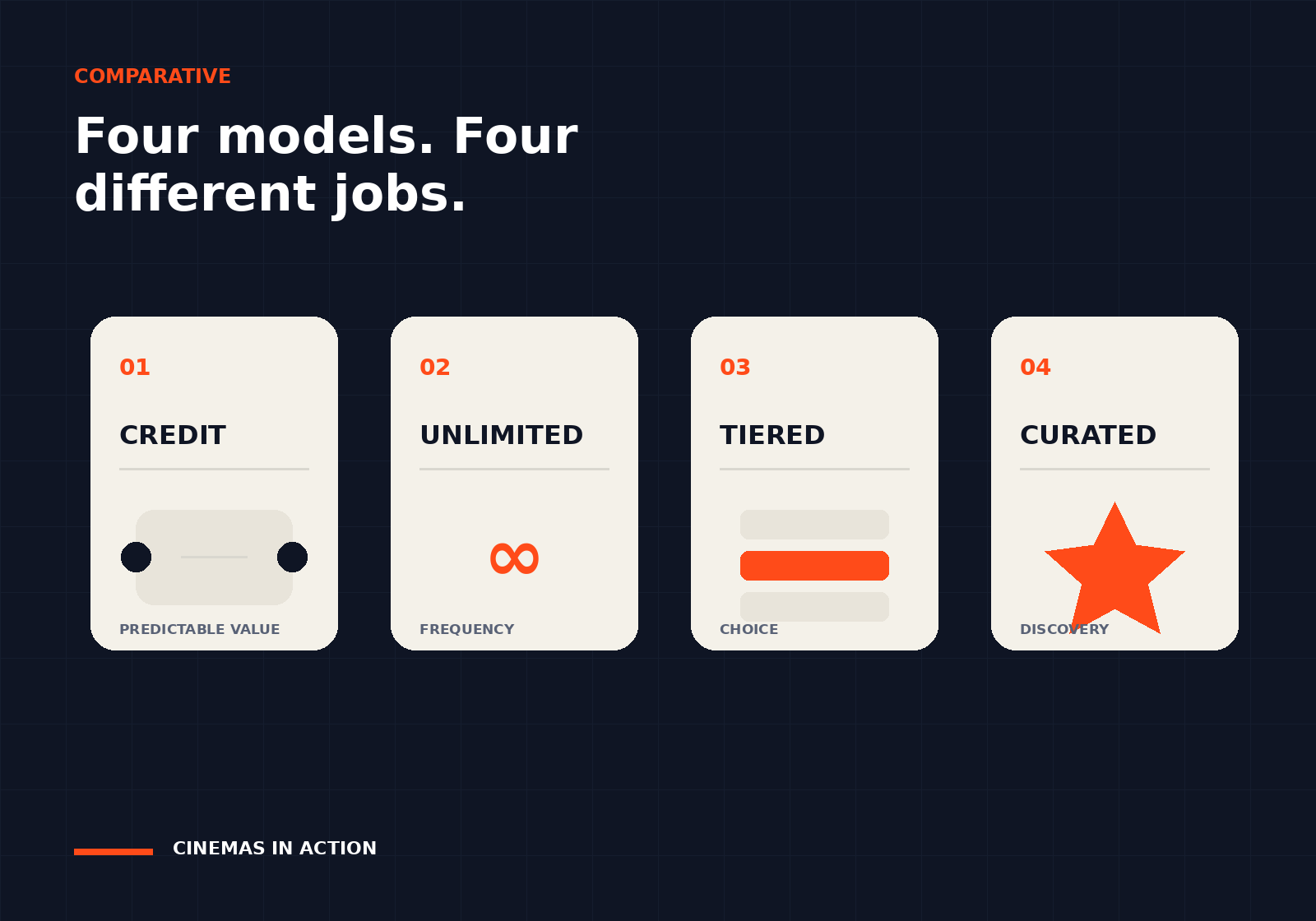
Four cinema membership models, and the behaviour each one is built to create
Monthly credits, tiered unlimited access, segmented passes and curated weekly tickets distribute value and risk in very different ways.
Published 7/22/2026
The idea
Cinema memberships can be built around different value engines: a monthly ticket credit, tiered unlimited access, segmented time or party passes, or a curated weekly ticket bundled with another service.
Evidence
The current structures and terms are visible on official pages. Cineplex also publishes member and savings claims, while the other examples provide little public performance data. None supplies enough comparable economics to identify one universally superior model.
Operator takeaway
Choose the membership architecture after defining the behaviour and risk you want to manage. Credit models cap liability, unlimited tiers maximise perceived access, segmented passes protect capacity and curated tickets reduce choice overload.
Try this
Model three simple options using your own attendance and customer data: one ticket credit, a restricted frequent-viewer pass and a curated monthly bundle. Test demand before building a complex multi-tier product.
Measure
Track acquisition, activation, visits, unused entitlement, churn, companion tickets, premium upgrades, concession contribution, heavy-user cost, customer-service contacts and the share of activity that is incremental.
Watch out for
Complex menus can lower conversion, unlimited offers can create heavy-user exposure, rollover liabilities can accumulate and third-party bundles may weaken the cinema’s control of customer data.
Membership is a risk design decision
Membership is often discussed as a loyalty tactic, but the structure determines who carries usage risk, how customers perceive value and what behaviour the cinema encourages. The four examples use different engines rather than variations of one product.
1. Monthly credit: CineClub
CineClub gives the member one monthly ticket credit plus lower-priced additional tickets, food and drink benefits and waived online fees. The credit caps the core monthly entitlement, while rollover reduces the feeling of losing value. The operator reports scale and member savings, but public sources do not show churn, breakage or incremental attendance.
2. Tiered unlimited: Pathé
Pathé uses a menu of under-26, standard, premium and companion options. Tiering can separate price sensitivity from willingness to pay for premium formats or an additional guest. The risk is choice complexity: customers must understand the difference quickly, and the operator must manage upgrades, downgrades and format capacity.
3. Segmented unlimited: UGC
UGC’s range includes weekday, weekend, seven-day, Duo, under-26 and family variants. Time and party restrictions let the operator shape demand and price risk differently. A weekday pass can target quieter capacity; a Duo or family plan sells a party benefit rather than only individual frequency.
4. Curated entitlement: MUBI GO
MUBI GO combines streaming with one selected cinema ticket each week. The value is curation and cross-platform discovery, not unrestricted frequency. The same-day QR process also limits reservation behaviour. For partner cinemas, the unresolved questions are settlement economics, customer ownership and whether the ticket reaches new customers.
How to choose
Use a credit model when liability control and simple value are priorities. Use restricted access when the objective is to move demand into specific days or formats. Use tiering when the estate has meaningful premium differences. Use curation when choice overload or an adjacent audience partner is central to the proposition.
Model the heavy and light users
Any membership forecast should include low, medium and high usage. Calculate film-rental and operational cost by visit, companion behaviour, concession contribution, unused entitlements and cancellation. An average can hide a small group of very expensive members or a large group who never activate.
Keep the first test simple
A cinema does not need six tiers at launch. Test one ticket credit against one restricted pass or curated bundle. Use a landing page or member survey to measure preference, but do not treat stated interest as purchase. A real paid pilot is the stronger test.
Editorial judgement
There is no single best cinema membership. These examples show four strategic choices. The appropriate model depends on capacity, customer frequency, programming breadth, data ownership and appetite for usage risk. Complexity should be earned by evidence, not copied from a larger operator.
Stay updated
Get new Cinemas in Action briefings by email.
Occasional operator briefings and new case studies — no marketing, no third parties.