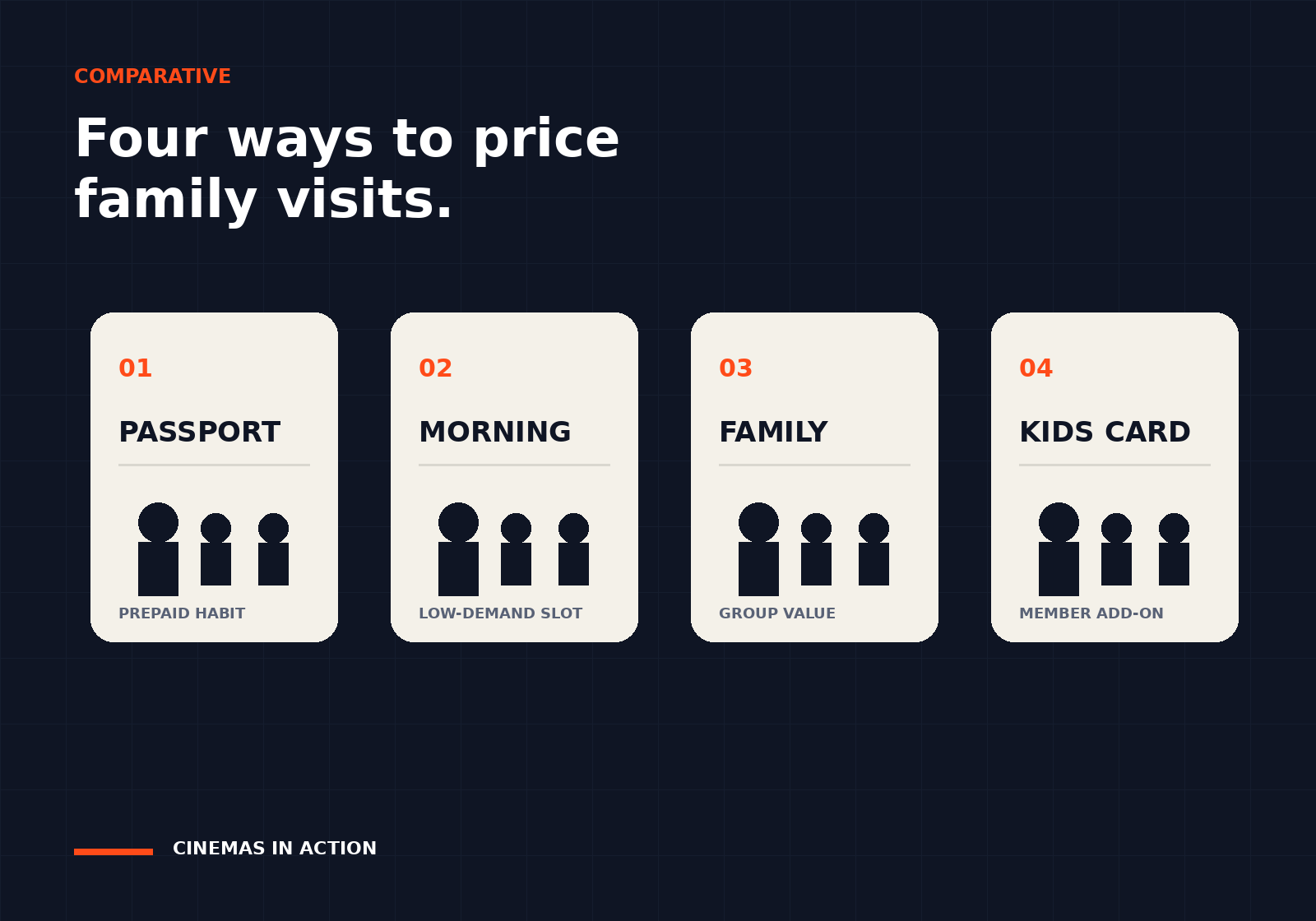
Four ways cinemas structure family value
A comparison of prepaid passports, fixed-price mornings, bounded family bundles and child membership add-ons shows why “family pricing” is not one mechanism.
Published 7/22/2026
The idea
Family offers can create different behaviours depending on their architecture: a prepaid series, a very low recurring daypart, a tightly bounded party bundle or a child add-on to an adult membership.
Evidence
The prices, eligibility rules and operating boundaries are observable on official operator pages. None of the four examples publishes enough uptake, incrementality or margin data to identify a proven winner.
Operator takeaway
Do not begin with “a family discount”. Begin with the behaviour you want: repeat commitment, off-peak occupancy, a larger family party or retention of member households. Then design the restriction and measurement around that goal.
Try this
Choose one behaviour and run a six- to eight-week test. Keep the offer simple, specify films and times, attach data capture where possible and compare results with similar sessions outside the test.
Measure
Track party size, repeat visits, pass redemption, family-ticket yield, concession spend, new household capture, no-shows, full-price displacement and return visits after the promotion ends.
Watch out for
Very low prices can fill seats without improving contribution. Complex eligibility creates front-of-house friction, while prepaid products can disappoint customers if capacity or film choice is too limited.
Four offers, four jobs
These family offers look similar at headline level because all reduce or package price. Operationally, they are designed to do different jobs. Marcus asks families to commit to a series. Cinemark creates a predictable low-price morning habit. Event protects the offer with membership, time and format boundaries. Cineville tested whether an existing adult member household would pay for a child add-on.
1. Prepaid repetition: Marcus
The Kids Movie Magic Passport turns a set of inexpensive children’s films into a prepaid bundle. The customer commits before knowing exactly how many screenings they will attend. For the cinema, that creates cash and repeat intent. The risk is breakage, capacity frustration or a low effective yield if high-use customers would have attended anyway.
2. A weekly ritual: Cinemark
Summer Movie Clubhouse uses a fixed $1.75 ticket, a default Wednesday 9:30am slot and snack discounts. Its strength is clarity. Families can understand when it happens and what it costs. The commercial question is whether concessions, sponsorship or later visits compensate for the deliberately low ticket yield.
3. Bounded party value: Event Cinemas
Event’s Family Saver and Grandparents Pass show how operators can constrain a family offer. The member requirement, before-5pm timing, selected films, original-session rule and premium exclusions protect yield and target underused capacity. The trade-off is complexity: every condition must be visible before purchase and easy for staff to explain.
4. A member-household add-on: Cineville
The historical Cineville Kids Card trial treated the child product as an extension of an adult membership. That can deepen household loyalty and increase companion visits. It also raises scheduling and value questions: a child card will only feel worthwhile if enough age-appropriate films are available across the validity period.
Match the mechanic to the objective
A cinema trying to build repeat visits should favour a prepaid multi-film product. A cinema trying to fill a quiet slot should use a clear recurring daypart. A cinema trying to broaden who brings children might test a grandparent bundle. A membership scheme trying to retain households could test a child add-on. Mixing all four objectives into one offer usually creates confusing terms.
Protect the test
Define the eligible films, sessions, formats and capacity before launch. Decide how companions are treated, what happens if a screening sells out, whether unused entitlements expire and how refunds work. A low-price offer can still damage trust if redemption feels uncertain.
Measure beyond admissions
Compare family-party contribution, not just seat count. Include ticket yield, party size, concession spend, new-account capture, visit frequency, full-price displacement and later return. For prepaid products, separate sold entitlements from redeemed visits and report breakage transparently.
Editorial judgement
The examples provide a useful design menu but no conclusive performance ranking. Their value is in the contrast. Each makes a different behavioural bet and uses different boundaries. A cinema should select the smallest mechanism that answers its specific family-audience problem.
Stay updated
Get new Cinemas in Action briefings by email.
Occasional operator briefings and new case studies — no marketing, no third parties.