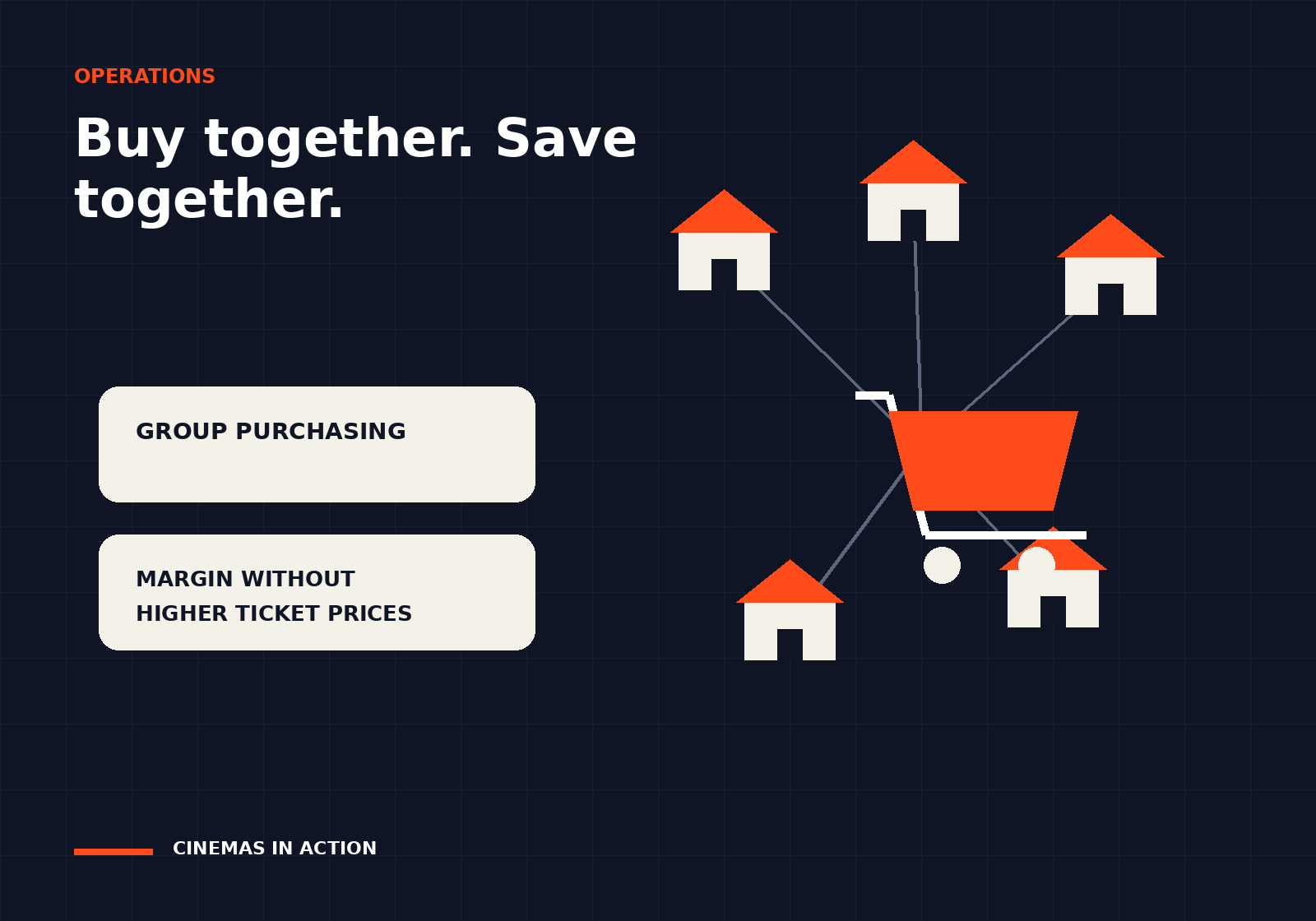
Can independent cinemas improve margin by buying together?
The Independent Cinema Alliance Marketplace reports substantial purchasing volume and savings, illustrating how collective procurement can improve economics without raising audience prices.
Published 7/22/2026
The idea
Independent cinemas aggregate purchasing demand so they can negotiate national or group terms for supplies and services without needing the scale of a major circuit.
Evidence
ICA reports $13 million in purchasing volume, nearly 20% savings and around 1,600 participating screens. These are programme-reported commercial figures; the baseline, fee structure and cinema-level distribution of savings are not public.
Operator takeaway
Margin improvement does not always require higher ticket or concession prices. Shared procurement can create value behind the scenes, but only when savings are measured net of fees, switching costs and service quality.
Try this
Begin with one transparent category, such as cleaning supplies, paper goods or a common concession input. Collect current invoices, agree comparable specifications and run a time-limited group tender.
Measure
Compare like-for-like unit cost, delivery reliability, minimum-order effects, programme fees, staff time, supplier concentration and net annual savings by participating cinema.
Watch out for
Headline percentage savings can conceal weak baselines, selective categories or volume assumptions. National contracts can also reduce local flexibility or create dependence on a small supplier group.
The idea behind the Marketplace
The Independent Cinema Alliance Marketplace uses collective purchasing power to give smaller operators access to negotiated products and services. The categories named by ICA include concessions and food and beverage, janitorial supplies, technology and seating. The mechanism is operational rather than audience-facing: reduce the cost of running the cinema before asking customers to spend more.
What was reported
In January 2026, ICA reported approximately $13 million in purchasing volume, nearly 20% savings and participation representing about 1,600 screens. Those numbers are commercially meaningful enough to justify attention. They remain programme-reported figures, however, and the public announcement does not show the denominator used for the savings calculation, the spread of results by category or the economics for individual cinemas.
Why aggregation can work
Independent cinemas often buy many of the same inputs but negotiate separately. Aggregation can improve price, payment terms, freight and access to suppliers. It may also reduce duplicated procurement effort. The gain is strongest when the group standardises what is being compared, shares credible baseline invoices and avoids allowing a headline discount to substitute for an assessment of quality and total delivered cost.
What operators should ask
A cinema should understand the programme fee, contract length, minimum order, delivery coverage, service levels, rebates and exit terms. It should also ask whether the quoted saving is against the cinema’s own historic price, a list price or a modelled benchmark. Without that, a large percentage can be difficult to interpret.
A low-risk starting point
A regional association does not need to build a full marketplace. It can begin with one category that has common specifications and sufficient spend. Cleaning products, paper goods or a staple concession input are usually easier to compare than technology or seating. The test should use actual invoices and include delivery, waste and staff time.
How to measure real savings
The relevant measure is net saving, not negotiated discount. Subtract programme fees, implementation time, changed delivery costs, storage requirements, waste and any reduction in quality. Report the median and range across cinemas so one unusually large operator does not make the whole programme appear stronger than it is.
Governance and trust
Group purchasing depends on reliable data and transparent rules. Members must know how suppliers are selected, whether the association receives rebates, how conflicts are managed and whether individual pricing remains confidential. Weak governance can quickly undermine the trust that makes aggregation possible.
Editorial judgement
The Marketplace is a strong case because it shifts the growth conversation from revenue to margin. The public evidence supports meaningful reported scale, but not a universal 20% saving for every cinema. The practical test is therefore to reproduce the buying discipline in one category and measure the full net effect.
Stay updated
Get new Cinemas in Action briefings by email.
Occasional operator briefings and new case studies — no marketing, no third parties.